International Community should take notice of miseries of Women in IHK: A Conference at EU parliament
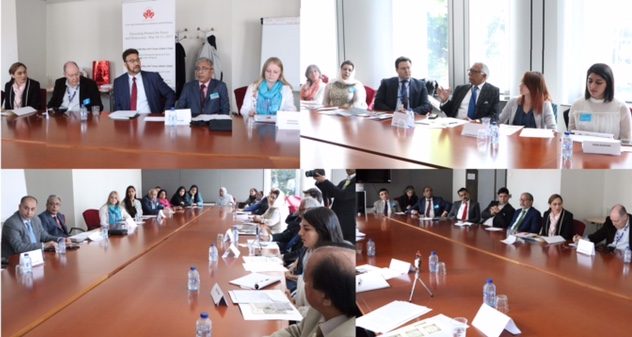
International Community especially European Union should take serious notice of the severe miseries of women in Indian Held Kashmir (IHK). It was stated in a statement at the conclusions of the two-day international conference on the role of Kashmiri women in the perspective of peace and education in South Asia.
The statement said, women and children are most affected victims of the hostile situation of IHK and it is the duty of the international community to decrease their hardships by playing an effective role for the right of self-determination of people of Jammu and Kashmir. Expressing grave concerns over the situation of women in IHK Kashmir, the statement asked the international organisations working for rights of women to pay immediate attention to the situation because a woman in the valley is facing miseries as a mother, a sister, a wife and a daughter. Many of the women lost their husbands and many lost their fathers and brothers.
The statement also condemned the ban on social media in IHK and said, India wants to press voice of the Kashmiris. International community which believes in the freedom of expression should stop India from imposing restrictions on social media which are an important tool in freedom of expression and freedom of speech.
The two-day International Conference on the role of Kashmiri women titled; “Educating Women for Peace and Democracy in South Asian Perspective” was held at European Parliament.
Kashmir Council-EU had arranged the event in collaboration with Friends of Kashmir Group based in Brussels, the capital of Belgium. The first day of the international conference was attended and addressed by a number of parliamentarians, human rights activists, experts and intellectuals from different countries. The second day of the event has contained a workshop on the role of women especially in educating them for peace and democracy. Member of European parliament Ms Julie Ward presented her suggestions during the workshop.
Professor Agnieszka Kuszewska of University Social Psychology of Poland, Dr Agnieszka Nitza of University of Collegium Civitas Warsaw, Chairman Kashmir Council EU Mr Ali Raza Syed, Ms Khaoula Siddiqi from Columbia Business School Canada, Ms Sadia Mir from the University of Westminster, UK, Ms Ifra Bukhari from University of Sheffield UK were among the speakers at the conference.
MEPs Sajjad Haider Karim, Amjad Bashir and Raja Afzal Khan welcomed the participants in the EU parliament while Ms Sadia Mir conducted the program.
MEP Sajjad Karim said, it was a great to welcome the high academics from different parts of Europe. He said, this conference is very timely because Kashmiri women are increasingly under pressure and they are facing true and emotional wounds.
Talking on the occasion MEP Amjad Bashir hailed the Kashmir Council EU for arranging this conference and said, it would be a great help for raising the rights of the people of Jammu and Kashmir especially role Kashmiri women in South Asian perspective.
Talking about the education of women in South Asia, host of the event MEP Afzal Khan said, poverty was the leading reason of the illiteracy among women. Many of the girls do not go to school, it means a large number of girls are deprived of education. He said, not educating women loses the potential of the nation.
In her speech of the expert on South Asian Affairs Professor Dr Agnieszka Kuszewska highlighted major challenges of women’s education in Pakistan and the general role of education in Pakistan’s economic, political and social development.
She said, education and literacy are necessary for a woman in order to empower her with new tools for public participation and improving their situation. About Pakistan’s female education, she said that according to the Constitution of Pakistan every Pakistani woman has a fundamental right to have an education. She added, a voice in public debates, participation in democratic practice is an inalienable part of human development and the key element of the state’s democratic progress. About Kashmir issue, she said, Kashmir conflict was necessitating arms race and resources investment on arms.
Another expert from Poland Dr Ms Agnieszka Nitza of Collegium Civitas Universty Warsaw spoke on the topic “Women Make Democracy Happen: India and Pakistan Comparison”.
Comparing the role of female politicians in both of the South Asian States, she said, while some strong women political personalities abound in Indian and Pakistani states’ history, some women politicians introduced controversial policies. For instance, Indira Gandhi proclaimed a state of emergency and indicated a coercive sterilisation program. Talking about Quota systems for women in Pakistani parliament, she said, it was to ensure the presence of female representatives in Pakistani politics, while Indian reservation policy lacks such measures on a state level.
Speaking on the occasion, Chairman Kashmir Council EU Mr Ali Raza Syed talked about the central role of education for peace and democracy in South Asia especially the education to women in India, Pakistan and Kashmir as saying the women suffer the same disempowerment everywhere in the world.
He drew the attention of the participants towards the women in the conflict areas like Kashmir as saying they not only suffer from the state of violence, chaos and lost social harmony, but also from the emotional pain of losing their loved ones. They face humiliations, torture, rape and deprivations and they see their sons, brothers, husbands or fathers undergoing worst state repressions. In Kashmir, however, the women are now taking care of newly blinded youth as well.
Mr Ali Raza assumed that healthy, educated and dignified women shall ensure the peaceful, educated, democratic South Asia, whose great potential is hostage to India’s stubborn refusal to Kashmiris democratic right to self-determination.
Chairman Kashmir Council EU said, the objective of this event is to highlight the role of women in South Asian perspective especially women in the conflict zone of Kashmir in order to learn from the experiences of western women in bringing peace and democracy to their regions. The role of women is very important for peacebuilding and democracy and they can make the society better through their specific role.
He said, women in Indian Held Kashmir are among the people of Kashmir suffering from the severe situation of that region. We believe in the peaceful promotion of the rights and freedoms in all parts of the world including Kashmir. He expressed a hope that the conference would contribute towards the richness of the debate and strength of the demands by the women of Kashmir.
Former EU Ambassador Mr Anthony Crasner told the delegates that European parliament’s report on India- EU relations had no mention of Kashmir.
Ms Ifra Bokhari talked about the structural problems such unpaid labour, massive gender imbalance and low state priority on gender uplift in South Asia.
Ms Sadia Mir shared her information in the context of a stance of UN commission on gender equality. She said, when women are involved to policies that contribute to far-reaching effects.
Pakistani Intellectual based Brussels Mr Kenith Roy quoted Madeline Albright who said, democracy without women participation is impossible.
Khaoula Saddiqi said, School in Indian-held Kashmir are being closed down for the extended periods because of the conflict that also affects the economy and creates poverty. She gave an example of a Kashmiri girl who was molested by Indian army men and resulted in uproar killed two Kashmiri boys. She said, young girl students taking on the army in the streets which are a sign of improvement females as well. She added, education for the women required a peaceful society.


