Interview of president AJ&K in La Libre Belgique
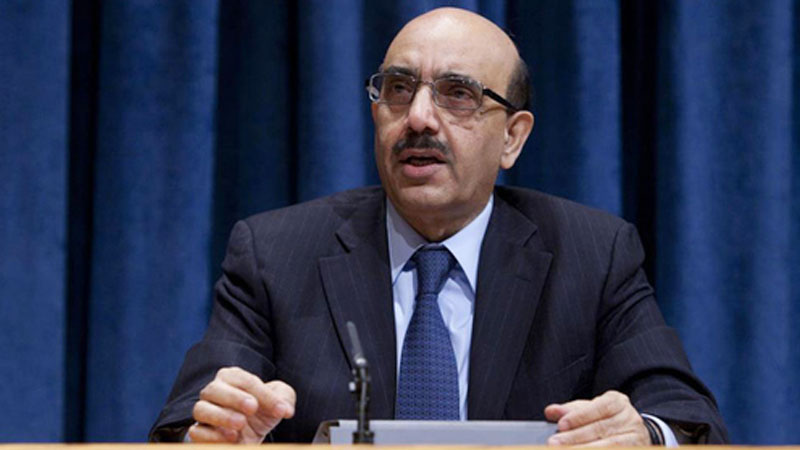
La Libre Belgique a leading and widely circulated French language newspaper of Belgium has published a full page interview of Sardar Masood Khan, the president of Azad Jammu in its edition of Monday 13th February 2017. The interview was conducted by senior journalist Ms. Sabine Verhest on the occasion of his visit to Brussels.
Following is the text of English translation of the interview:
The situation in Indian-dominated Kashmir, a majority Muslim region, has flared up in the last six months, without a glimpse of the beginning of pacification. Sardar Masood Khan, president of Azad Kashmir in Pakistan, traveled to Brussels this week to raise European leaders’ awareness of the conflict between the two nuclear powers in South Asia. “Europe has a moral and political responsibility to intercede more visibly in favor of the people of Jammu and Kashmir and the flag of human rights must also float high in Srinagar.”
Q: How would you describe the current situation in Kashmir?
A: It is terrible. The crisis was triggered by the assassination, by the Indian forces, of a popular figure of the struggle for freedom. There are indiscriminate killings of civilians, demonstrators. Hundreds of people were killed or injured, property was destroyed. This is the first time that binding has been used as an instrument of war; that an occupation force is targeting the eyes of those who seek freedom.
Q: What do you propose to revitalize the peace process?
A: The ball is in the Indian court. Pakistan is ready to commit itself with India for quite some time. You talk about the “peace process”, but before the peace process resumes, you have to start by having contacts, by having a form of dialogue. The bilateral discussions do not work; they don’t produce anything tangible for decades. As long as India is reluctant to engage in Kashmir, we have no other option but to turn to the international community and the United Nations. The Security Council should hold a debate on the situation. Its members cannot remain silent; they have to return to their own resolutions. If they care about peace and security, they have a responsibility to be proactive. They cannot simply say that the problem should be solved by India and Pakistan; especially when a crisis, like the one we have been experiencing for the past six months, has broken out. This matter is about the right of peoples to self-determination.
Q: Auto-determination can be realized in different ways. What is your objective?
A: India wants to eliminate the Kashmiris from the solution of the conflict. The people of Jammu and Kashmir should have the opportunity to determine by referendum their political future and who will have sovereignty over their territory, in conformation with the resolutions of the Security Council.
Q: India argues that Pakistan supports jihadi groups and that this support should stop before negotiating. Recently, Pakistan has placed under house arrest Hafiz Saeed, the head of a group, linked to the Mumbai attacks of 2008. Does this mean that you start to repress the jihadi groups that are also active in Kashmir?
A: India gives this argument to divert the attention of the atrocities it commits in Kashmir. It doesn’t give credible proof of jihadi activities in the region.
Q: It’s military base Uri has been attacked in September and 20 people were killed: the work, according to India, of the Pakistani jihadi movement…
A: There are two versions: the Indian version and ours. We don’t have sufficient evidence to conclude that attack has been committed by jihadis from Pakistan. We don’t know who has inspired, financed or organized the attack. The Line of Control (which separates Kashmir) is the most controlled of the world; with electronically monitored impassable fences at the Indian side. India is strong in communicating. But where are the proofs? Pakistan fights terrorism under all its forms. We are eliminating its reminiscences in all parts of the country. That is very clear. The action against Hafez Saeed has been taken in conformation with the constitutional law and in the framework of the engagement of Pakistan in regards to the international community.
Q: The Prime Minister Narendra Modi, since he took office in New Delhi, insists on the willingness of India to maintain good relations with its neighbors. He reached out to Pakistan, says he tried to restore relations, without results…
A: And do you believe him? If he would have been sincere, he would have restarted the dialogue with Pakistan on Kashmir and would have stopped killing Kashmiris. The problem doesn’t come from Pakistan, but from the mass murders, the genocide, the crimes against humanity, the human rights violations committed by India.
Q: The word ‘genocide’ is not a term to be used lightly…
A: I deliberately use it. Muslims are targeted since 1947-1948.
Q: What difference do you observe since the arrival in power of the Hindu nationalists?
A: I observe an increase in Hindu extremism, in intolerance in hatred against Muslims. It is the recipe for a disaster, not only for Kashmiris but also for the Indian civil society as a whole.
The additional small article, under Landmarks:
A conflict in high altitude.
Three geopolitical ambitions, Indian, Pakistani and Chinese, clash in Kashmir. It is here, more specifically, that the Indian-Pakistani conflict crystallizes, born from the division of the British Indian empire in 1947. The princely state of Jammu and Kashmir, despite the fact that it was in majority a Muslim region, was at that time ruled by a Hindu maharaja who chose to turn to India instead of Pakistan. A first war broke out and ended in 1949 with the partition of Jammu and Kashmir between the two countries, within between the Line of Control installed by the United Nations. Azad Kashmir and Gilgit-Baltistan are on the Pakistani side. Since then, other conflicts drenched the region in blood, but never an enduring solution could be found between the two powers.
Political movements and radical armed groups have appeared in the region controlled by India to ask for more autonomy or for the annexation to Pakistan. Islamic militants also infiltrated in the region to perpetrate attacks Numerous Kashmiris of the Srinagar valley ask today for freedom and the end of what they call the Indian occupation. But there are also youngsters that choose the armed fight and radical Islam to demand independence.


